


Architecture, purpose, and crew wellbeing converge to redefine the codes of modern yacht design. Dutch shipyard OCEANCO presents M/Y Leviathan and introduces a profound paradigm shift.
WORDS BY Claire Pitchie
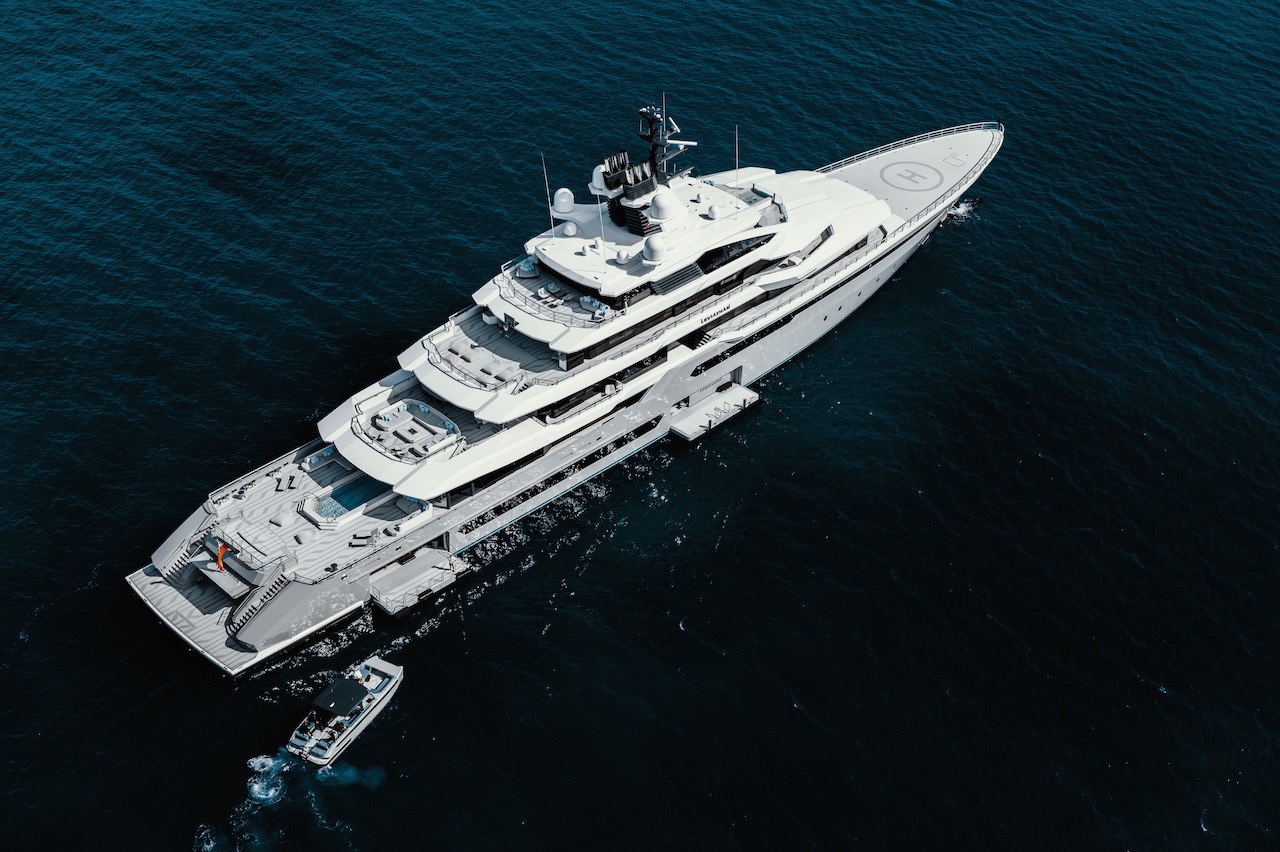
The launch of a 111-meter superyacht is always a milestone, but the delivery of Oceanco’s Leviathan — the diesel-electric colossus formerly known as Project Y722 — represents a profound paradigm shift in naval architecture and the very concept of life at sea.
Commissioned by Gabe Newell — a visionary and highly experienced owner who officially became the proprietor of the Oceanco shipyard on August 1, 2025 — and driven by a clear mission of teamwork and community, this vessel deliberately challenges rigid maritime traditions.
Every structural, technical, and aesthetic choice stems from a singular, unyielding philosophy: placing the human experience at the center of the design and recognizing the crew as the true heartbeat of the vessel.
This approach is immediately visible in a revolutionary interior layout designed to accommodate up to 26 guests and 37 crew members by dissolving traditional spatial hierarchies.
Conceived by Mark Berryman Design, the interiors were shaped by the owner’s firm belief that a yacht should function as a unified community, bringing people together and fostering shared experiences.
Prime locations that conventional yachting would reserve exclusively for guests have been reimagined to equally welcome the staff.
On the bridge deck, where an aft saloon would typically be located, sits a monumental communal gaming lounge equipped with fifteen gaming stations, two racing simulators, and ample lounge seating; a dynamic space that also serves as a quiet area for crew learning and professional development.
Similarly, what would traditionally be the main deck saloon has been transformed into a spacious communal mess, capable of hosting up to 54 people for combined dining.
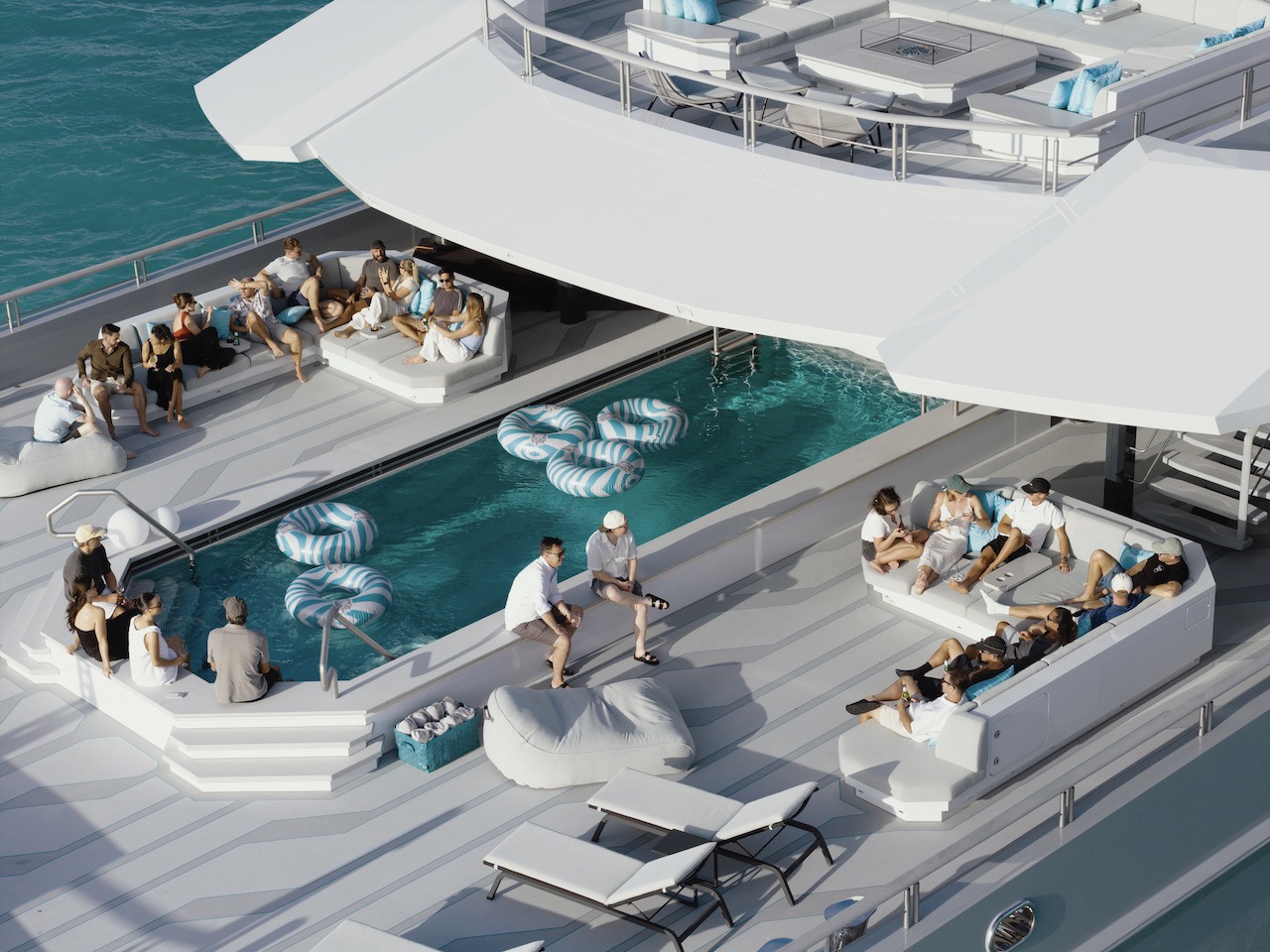
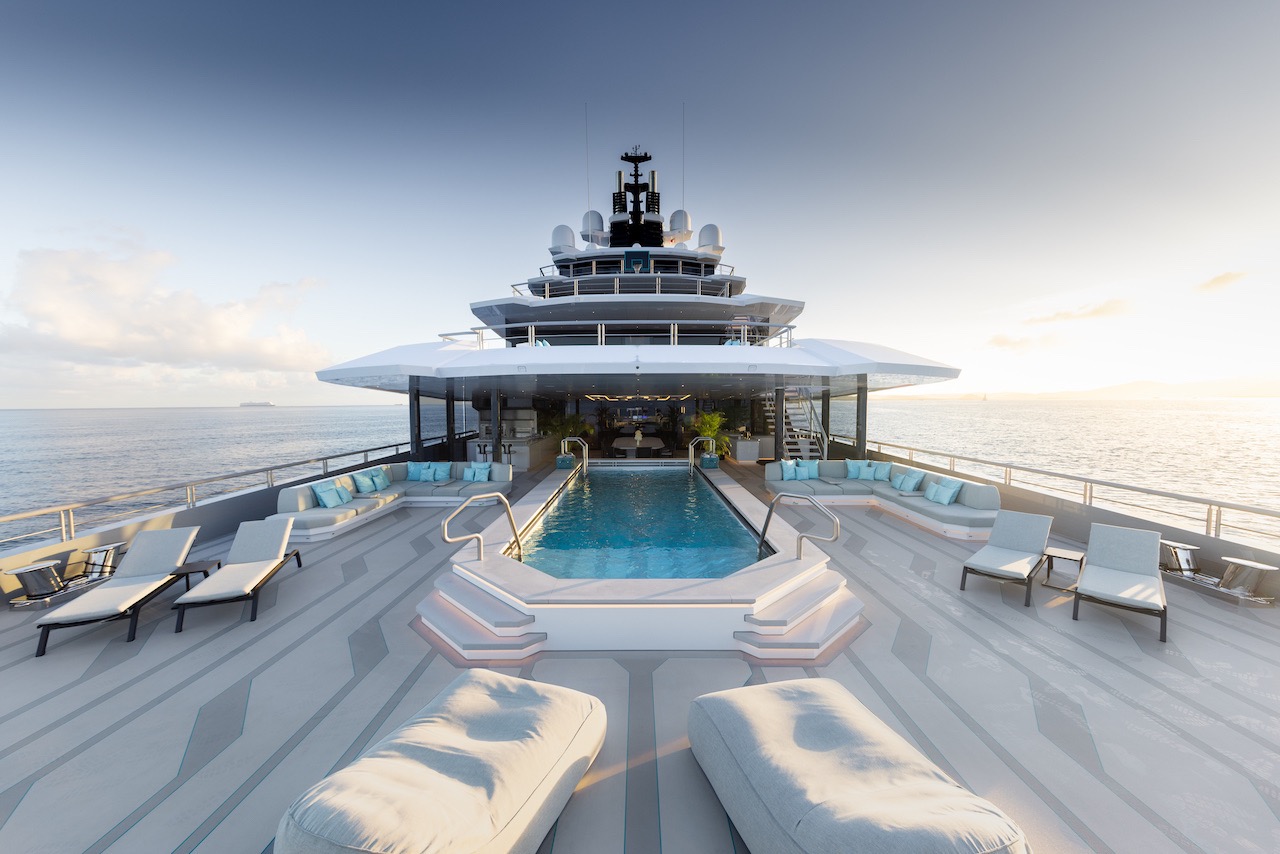
This philosophy elevates the quality of life onboard and explicitly focuses on long-term crew well-being and retention, with private quarters featuring sophisticated oak and deep wenge finishes. Leisure areas are open to everyone, including a full-sized basketball court and a recreational sun deck with a whirlpool.
From a material standpoint, the design rejects effervescent luxury trends in favor of intelligent, low-maintenance solutions based on a strictly crew-centric approach. The goal, deeply shared by Newell, is to free the crew’s time from routine maintenance chores so they can focus on higher-value engagement with guests and their own personal well-being.
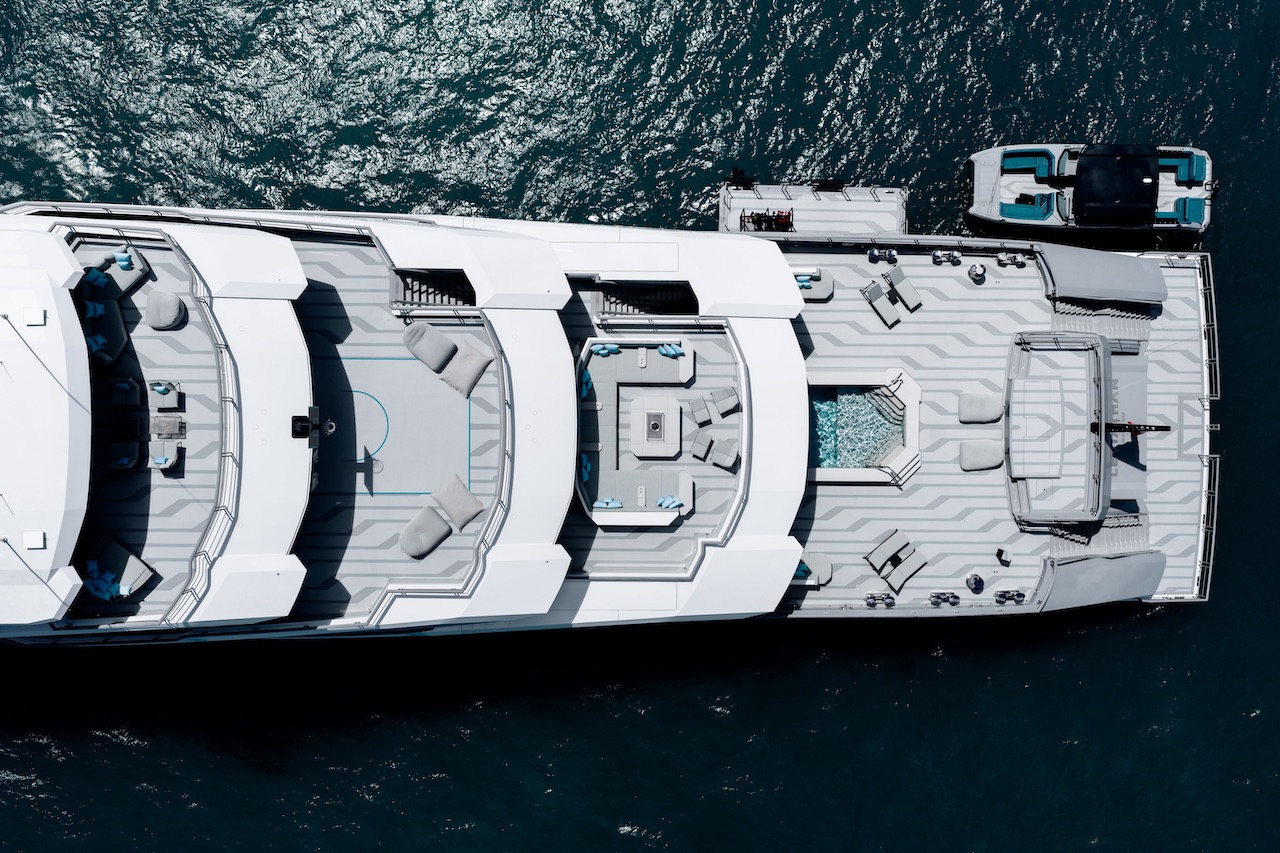
For the exterior, Gilles Vernhet and the Oceanco Design team blended functionality with an avant-garde aesthetic, creating a bold, forward-leaning silhouette that flows smoothly into strong prismatic forms. The yacht drastically reduces the need for repetitive polishing by replacing traditional polished wood-capped handrails and teak decks with synthetic alternatives and bead-blasted stainless steel railings, while even the specialized off-white exterior paintwork was selected to minimize the frequency of washdowns.
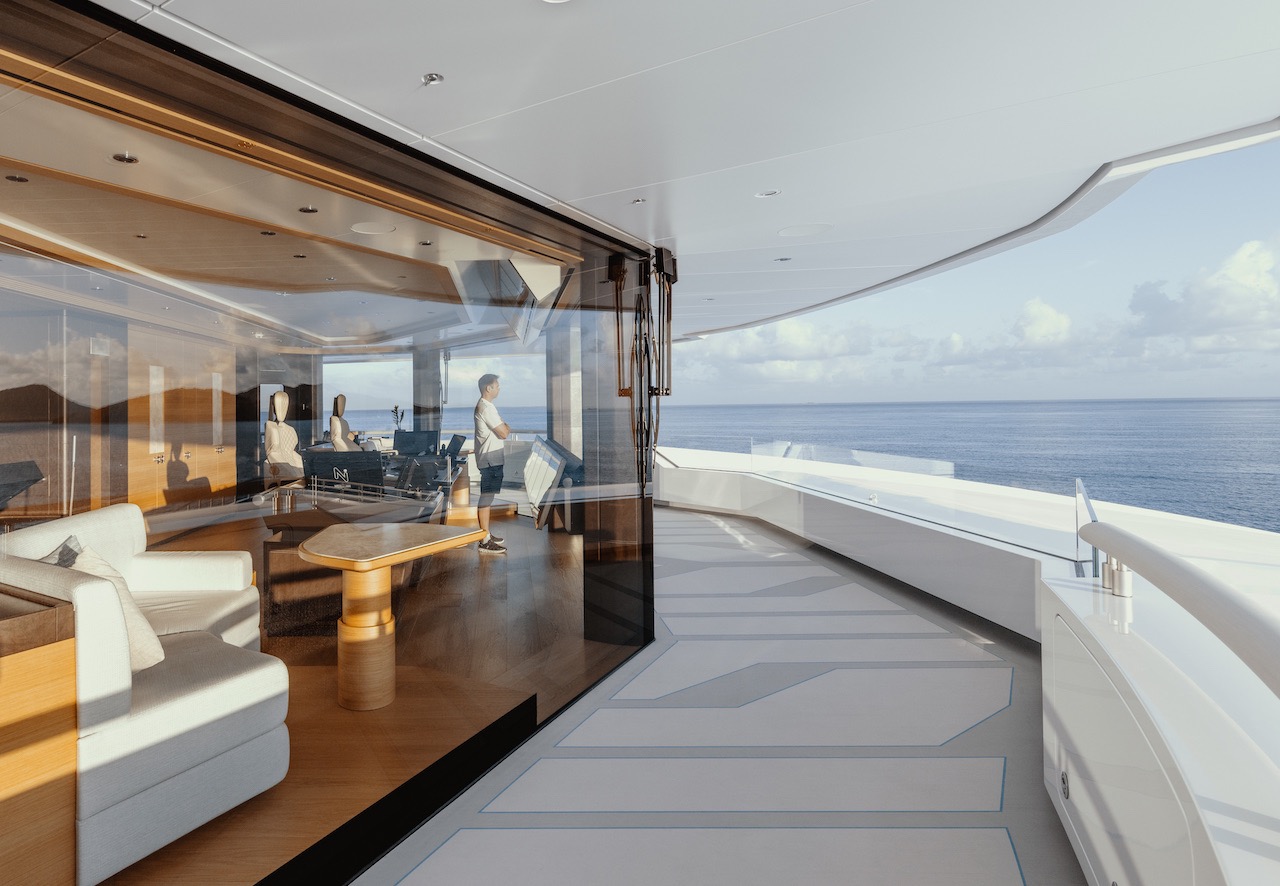
This relentless drive for innovation sparked unprecedented technological collaborations, starting with the custom Bolidt decking that features fully synthetic exterior walkways with a geometric pattern mirroring the yacht’s lines. Jointly developed by Bolidt, Oceanco, and the crew, this custom compound maximizes long-term durability while drastically improving heat dissipation across the decks.
Moving inside, the tactile resilience of the interior surfaces selected by Mark Berryman Design integrates leathered and honed stone finishes alongside natural wool carpets, offering an experience of tactile luxury combined with effortless upkeep and high resistance.
Finally, ensuring atmospheric purity throughout the vessel, Leviathan is one of the first yachts of this immense scale to implement a custom, large-scale air filtration and monitoring system developed by VFA Solutions.Beneath the surface, the technical architecture is as sophisticated as the living spaces.
During development, Oceanco and Lateral Naval Architects collaborated with the MARIN institute on an extensive model testing campaign to optimize seakeeping and onboard comfort. The hull represents the most advanced evolution to date of Lateral’s DE-Series (Diesel-Electric), a hull form family born in 2010 engineered for large yachts operating at moderate speeds with podded propulsion.
“What makes Leviathan so unique is the way she came to life. From the very start, we knew nothing about her would be done in a traditional way. We were welcomed into the team alongside Gabe and everyone who would ultimately be involved in operating her. It is this level of collaboration that sets Leviathan apart from anything we’ve built before. We’re incredibly proud of the way she was developed, and following her successful sea trials, we can now say she’s the most comfortable yacht ever designed, built, and delivered by Oceanco.”
“A sanctuary of comfort where silence meets strength, Leviathan wrapped in her sharp lines represents a superb synergy of form and function” – Dan Morgan, YTMC Managing Director –
“She is not just a high-performance vessel. She is a working ecosystem, designed to support everything from world-class hospitality to scientific research. That is what happens when you put people and purpose, at the center” – Charlie Birkett, CEO and Co-Founder of Y.CO –
James Roy, Managing Director of Lateral, explains that a refined electric architecture forms the core of Leviathan’s technical backbone. By precisely optimizing the beam, waterplane shape, and metacentric height (GM) targets, the team achieved a natural roll period exceeding 12 seconds, resulting in exceptional stability both at anchor and underway.
This is further enhanced by a seawater ballast system that maintains optimal loading conditions, alongside a stabilization system combining Quantum MagLift and XT Fins. Propulsion is delivered by two ABB DO980P Azipods paired with custom five-blade propellers, meticulously engineered to minimize pressure levels.
Model-scale cavitation testing and precise structural tuning of the steel Azipod foundations successfully eliminated both high- and low-frequency hull vibrations. The results from sea trials surpassed the most optimistic expectations, leaving Leviathan’s Captain, Alan Pike, astounded by how remarkably quiet and smooth the vessel handles, even at full speed.
A cornerstone of this silent operation is the 5.5 MWh battery system, which enables silent nighttime operations while its peak-shaving capabilities optimize engine performance, reducing fuel consumption and extending maintenance intervals.
Furthermore, the diesel-electric drive allowed the engine room to be positioned much further forward than on a conventional yacht of this size. This engineering flexibility allowed a significant portion of guest accommodation to be moved aft — traditionally the engine room space, but hydrodynamically one of the most comfortable and stable parts of the yacht in terms of motion.
The launch of the 111-meter colossus Leviathan is not an isolated milestone, but rather the central piece of a much larger, highly coordinated maritime vision. Driven by the pioneering vision of owner Gabe Newell, this avant-garde private fleet breaks down the rigid conventions of luxury yachting.
Leviathan does not sail alone; it operates in perfect synergy with Draak (the 92.8-meter colossus formerly known as Tranquility). Together, they completely redefine the traditional concept of a mothership and its support vessel. They are not merely two separate yachts traveling in the same direction, but two halves of a single, unified floating ecosystem engineered to complement each other in every technical, aesthetic, and functional aspect.
While Leviathan embodies the beating heart of the community onboard — redefining interior layout by placing the human experience and the crew at the center of naval architecture — Draak expands its logistical, operational, and exploratory capabilities.
To maximize the operational efficiency of the fleet, Oceanco simultaneously completed the comprehensive rebuild and transformation of Draak at its Zwijndrecht facilities.
Conceived to operate in perfect harmony and functional consistency with the flagship, this highly interconnected refit required intense engineering collaboration coordinated by YTMC.
The development team literally rewrote the original yacht’s DNA to adapt it to its new role. To clear the main deck for a massive tender deck, engineers removed the upper deck aft helideck. This new space was equipped with heavy-duty C-davits and a 12.6-tonne jib crane specifically designed to handle a dedicated dive tender. To integrate a safer boarding platform with retractable fenders and swim stairs, the hull was also extended by just over one meter at the stern.
Internally, Draak’s metamorphosis closely mirrors the functional and communal logic of the flagship. The former beach club and spa area was converted into a fully equipped dive center complete with a decompression chamber.
The main deck saloon has become a large crew mess, while the main saloon now houses a dedicated chef’s lab to facilitate intimate dining experiences for both crew and guests. This setup is supported by new adaptable cabins for extra fleet personnel.
Overseen by original builder Edwin Schneider, this refit required a total overhaul of ventilation and electrical systems, as every change disrupted the existing architecture.
On the flagship side, Leviathan replaces a traditional beach club with a marine lab and medical unit, turning the superyacht into a research platform.
As Charlie Birkett, CEO and Co-Founder of Y.CO, highlights, the vessel operates as a fully integrated, working ecosystem engineered to bridge the gap between world-class luxury hospitality and rigorous scientific research.
To ensure autonomy during remote expeditions, it features an onboard hospital and a 3D printing workshop. This allows the crew to make replacement or custom parts directly on board, ensuring self-sufficiency during long ocean crossings.
By officially joining Inkfish — an organization embedded within Gabe Newell’s fleet — Leviathan becomes a cornerstone of modern ocean exploration. This framework grants global researchers unprecedented access to remote marine environments and cutting-edge oceanographic technology.
Furthermore, this collaborative ecosystem is closely linked to the remarkable full-ocean-depth submersible deployed on the research vessel R/V Dagon, which continuously unlocks breakthrough discoveries at the deepest coordinates of the sea. Reflecting on this vision, Gabe Newell emphasizes that yachts possess a massive, untapped potential to serve as platforms for scientific research. He notes that true innovation stems from recognizing one’s role within the global community and ensuring that a vessel’s presence actively adds long-term value to the world around it.
Gabe Newell was deeply involved in every phase of design development and construction, fostering an environment of absolute openness between Oceanco, Mark Berryman Design, YTMC, Y.CO, and a vast network of craftspeople and co-makers.
For Patrick Casanova of Oceanco, the project was an unforgettable journey. It is entirely fitting, then, that a massive glass panel is permanently installed within Leviathan’s main staircase. Engraved into its surface are the names of nearly 3,000 contributors — craftspeople, engineers, crew, and partners — who brought this landmark project to life. It serves as a striking design feature and a permanent reminder that this extraordinary fleet was ultimately built by people, for people.
By combining industry-defining performance, deep-sea capability, and cultural substance, Leviathan sets a forward-thinking blueprint for the future of how superyachts can contribute to society long after they leave the shipyard. ∎
Photos © Oceanco